Medieval Translator – English to Medieval
Convert modern English into authentic medieval language instantly with accurate thou, thee, and tone-based translation.
Medieval Translator (2026): Convert Modern English into Authentic Medieval Speech Instantly
A medieval translator is a powerful tool that converts modern English into historically inspired medieval-style language—complete with period vocabulary, grammar, and tone.
Instead of plain text, it transforms:
- “You are welcome” → “Thou art most welcome”
- “Please help me” → “Prithee, lend me thy aid”
In 2026, the demand for medieval English translators has grown rapidly across the United States. From RPG players and writers to educators and content creators, people want language that feels immersive, expressive, and historically inspired.
Try the Medieval Translator Tool
Use the tool above to instantly:
- Convert modern English into medieval speech
- Switch between tone styles (Knight, Peasant, Noble, etc.)
- Copy and reuse translations anywhere
For advanced usage, explore:
- English → Medieval Translator
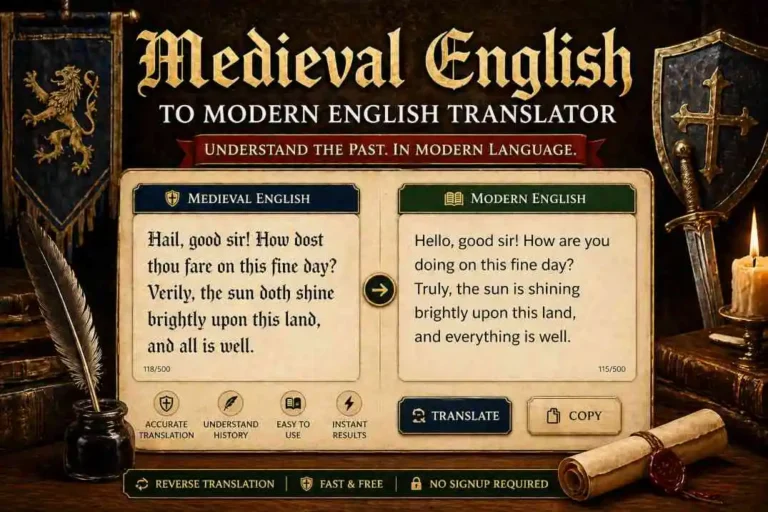
- Medieval → Modern Translator
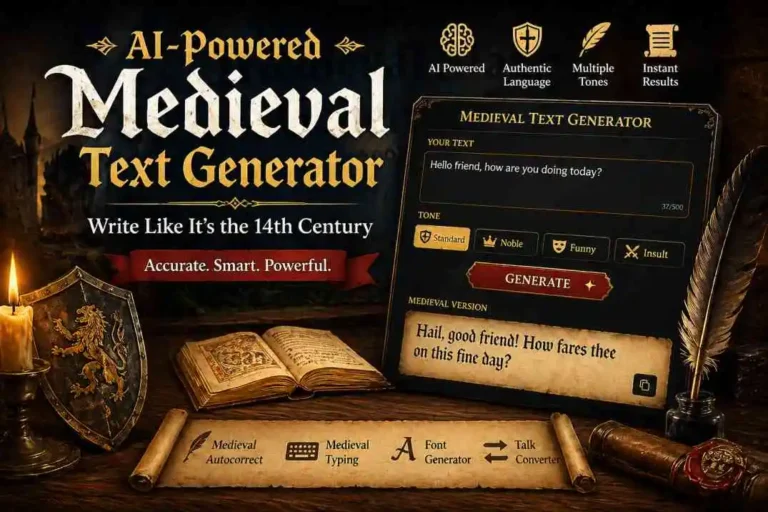
- Medieval Text Generator
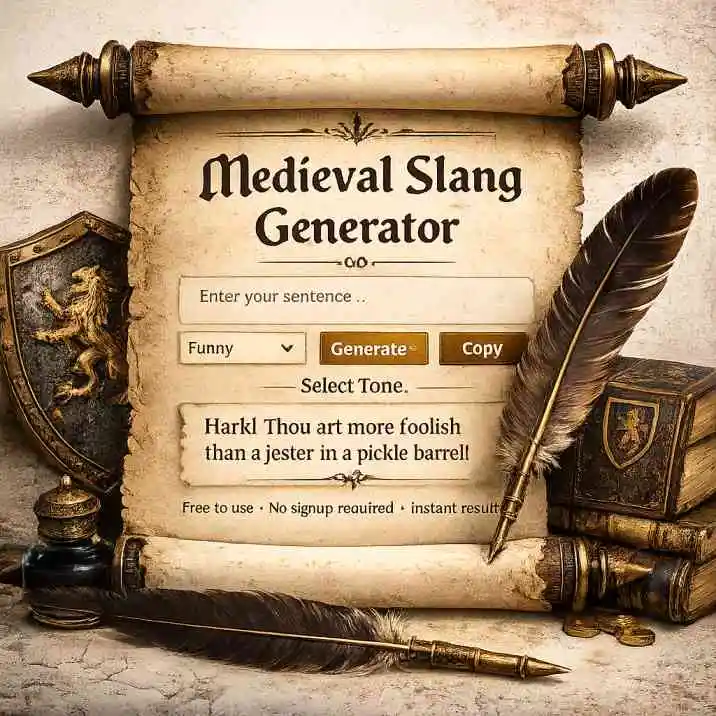
- Medieval Slang Generator
What Is a Medieval Translator?
A modern to medieval translator is a stylistic language converter—not a strict historical translator.
It recreates what people expect medieval English to sound like:
- Archaic pronouns (thou, thee, thy)
- Verb endings (-eth, -est)
- Formal tone and structure
This is often called:
- medieval speak translator
- medieval talk translator
- medieval speech translator
How to Use This Medieval Translator (Step-by-Step)
Using this tool is simple:
- Select a tone (Knight, Peasant, Noble, etc.)
- Enter your modern English text
- Translate instantly (live typing supported)
- Copy and use anywhere
Try short sentences first to understand patterns.
English → Medieval English: Core Language Rules
To properly translate into medieval English, you need to understand key transformations.
1. Pronoun System (Thou / Thee / Thy)
| Modern | Medieval |
|---|---|
| You | Thou |
| You (object) | Thee |
| Your | Thy / Thine |
Example:
“You are my friend” → “Thou art mine companion”
2. Verb Conjugation
| Modern | Medieval |
|---|---|
| Has | Hath |
| Does | Doth |
| Knows | Knoweth |
| You do | Thou dost |
3. Signature Words
Common replacements:
- Please → Prithee
- Yes → Aye
- No → Nay
- Before → Ere
- Soon → Anon
Tone Modes: The Biggest Advantage
Most tools ignore tone—but medieval language was highly social.
Our translator supports:
| Tone | Style | Use Case |
|---|---|---|
| Standard | Balanced | General use |
| Knight | Formal, honorable | RPG, roleplay |
| Peasant | Simple, rustic | Comedy |
| Noble | Elegant, royal | Invitations |
| Bard | Dramatic, poetic | Storytelling |
| Monk | Religious tone | Historical writing |
For example tools, see:
Modern vs Medieval vs Old English (Important Difference)
Many users confuse these terms:
| Type | Era | Difficulty |
|---|---|---|
| Old English | 450–1150 | ❌ Very hard |
| Middle English | 1150–1500 | ⚠ Medium |
| Popular Medieval | Modern adaptation | ✅ Easy |
This tool uses popular medieval style, which is readable and practical.
Real Translation Examples
| Modern English | Medieval Output |
|---|---|
| Hello friend | Hail, good companion |
| I need help | Prithee, I require thy aid |
| Thank you | I thank thee |
| Goodbye | Fare thee well |
For more examples, see:
Who Uses a Medieval Translator?
This tool is widely used by:
- D&D and RPG players
- LARP participants
- Writers and storytellers
- Content creators
- Students and teachers
Related tools:
Modern to Medieval Translator (Tone Example)
Input:
“I need your help right now.”
Outputs:
- Standard → “Verily, I require thy aid”
- Knight → “Upon mine honour, I require thy aid”
- Peasant → “Aye, I need thy help”
- Bard → “Hark! I require thy aid”
How to Speak Medieval English (Beginner Guide)
To speak naturally:
Step 1: Replace “you”
Use thou / thee / thy
Step 2: Add tone words
Verily, Forsooth, Hark
Step 3: Use contractions
’tis, ’twas
Step 4: Practice with tools
Try:
Medieval Vocabulary (Quick Reference)
Some essential words:
- Hail → Hello
- Aye → Yes
- Nay → No
- Prithee → Please
- Anon → Soon
- Ere → Before
Full list available in:
Why This Medieval Translator Is Better
Compared to basic tools:
| Feature | This Tool | Others |
|---|---|---|
| Tone system | ✅ Yes | ❌ No |
| Grammar handling | ✅ Advanced | ❌ Basic |
| Bidirectional | ✅ Yes | ❌ No |
| UX/UI | ✅ SaaS level | ⚠ Basic |
Explore More Medieval Tools
To get the best results, combine tools:
- English → Medieval Translator
- Medieval → English Translator
- Medieval Text Generator
- Medieval Slang Generator
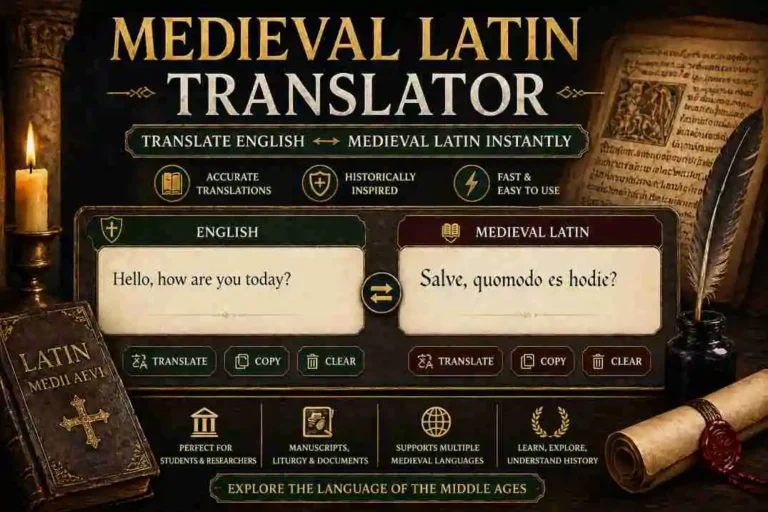
- Medieval Latin Translator
- Language Comparison Tool
Important Note on Accuracy
This is a stylistic translator, not academic Middle English.
✔ Designed for readability
✔ Based on popular medieval style
✔ Ideal for creative use
Conclusion
A medieval translator is more than a fun tool—it’s a gateway into historical language, storytelling, and immersive communication.
By combining:
- Grammar rules
- Tone awareness
- Vocabulary
You can create convincing medieval dialogue instantly.
Final Verdict
If you want the best results:
✔ Use tone-based translation
✔ Understand basic grammar rules
✔ Combine multiple tools
This gives you authentic + engaging medieval output
FAQs
What is a medieval translator?
A tool that converts modern English into medieval-style language.
Is it historically accurate?
It is stylistically accurate, not academic.
Can I reverse translate?
Yes, using Medieval → Modern Translator.
How do I say “you’re welcome”?
“Thou art most welcome” or “’Twas mine honour.”