Annotated Runestone Gallery: Real Inscriptions, Explained
Every runestone below is real, currently standing (or museum-held), and has been studied and published by runologists. The transliterations and translations shown are the standard scholarly readings recorded in Rundata, the academic database of Scandinavian runic inscriptions, cross-checked against published research summarized on Wikipedia. None of this text was generated by this site’s translator tool — these are historical artifacts with their own documented readings, shown here so visitors can see what real Viking Age and medieval runic writing actually looks like, and how different it is from decorative “rune translator” output.
Why this page exists
Most “rune meaning” content online shows invented alphabets or decorative substitution ciphers with no connection to a real inscription. This gallery does the opposite: five specific, named, physically real stones, each with its Rundata reference number, findspot, and a citation trail a reader can follow. If you want to check any reading here against the primary academic source, search the stone’s signum (for example “Ög 136”) in the Rundata database.
The Rök Stone (Ög 136)

| Location | Beside Rök church, Ödeshög Municipality, Östergötland, Sweden |
|---|---|
| Date | Early 9th century, c. 800 AD |
| Height | Approximately 2.4 m (8 ft) |
| Script | Mostly Younger Futhark, with some older short-twig and cipher runes |
The Rök stone is the longest known runic inscription in the world — over 700 runes cover all five faces of the slab. It was raised by a man named Varinn in memory of his son Vámóðr, but most of the text is not a simple memorial formula. It moves into riddles, references to a legendary king (likely the Ostrogothic king Theodoric), and allusions to Norse myth, making it as much a monument to oral storytelling as to Vámóðr himself.
Opening line (transliteration): aft uamuþ stąnta runaʀ þaʀ ᛭ n uarin faþi faþiʀ aft faikiąn sunu
Translation: “In memory of Vámóðr stand these runes. And Varinn coloured them, the father, in memory of his dead son.”
Why it matters here: Rök sits right at the transition between the older 24-rune Elder Futhark tradition and the 16-rune Younger Futhark used through the Viking Age — several passages mix rune forms and even use a numerical cipher, which is part of why it’s still debated by runologists today. It’s a useful reminder that “the rune alphabet” was never one fixed, unchanging system.
The Jelling Stone (DR 42)
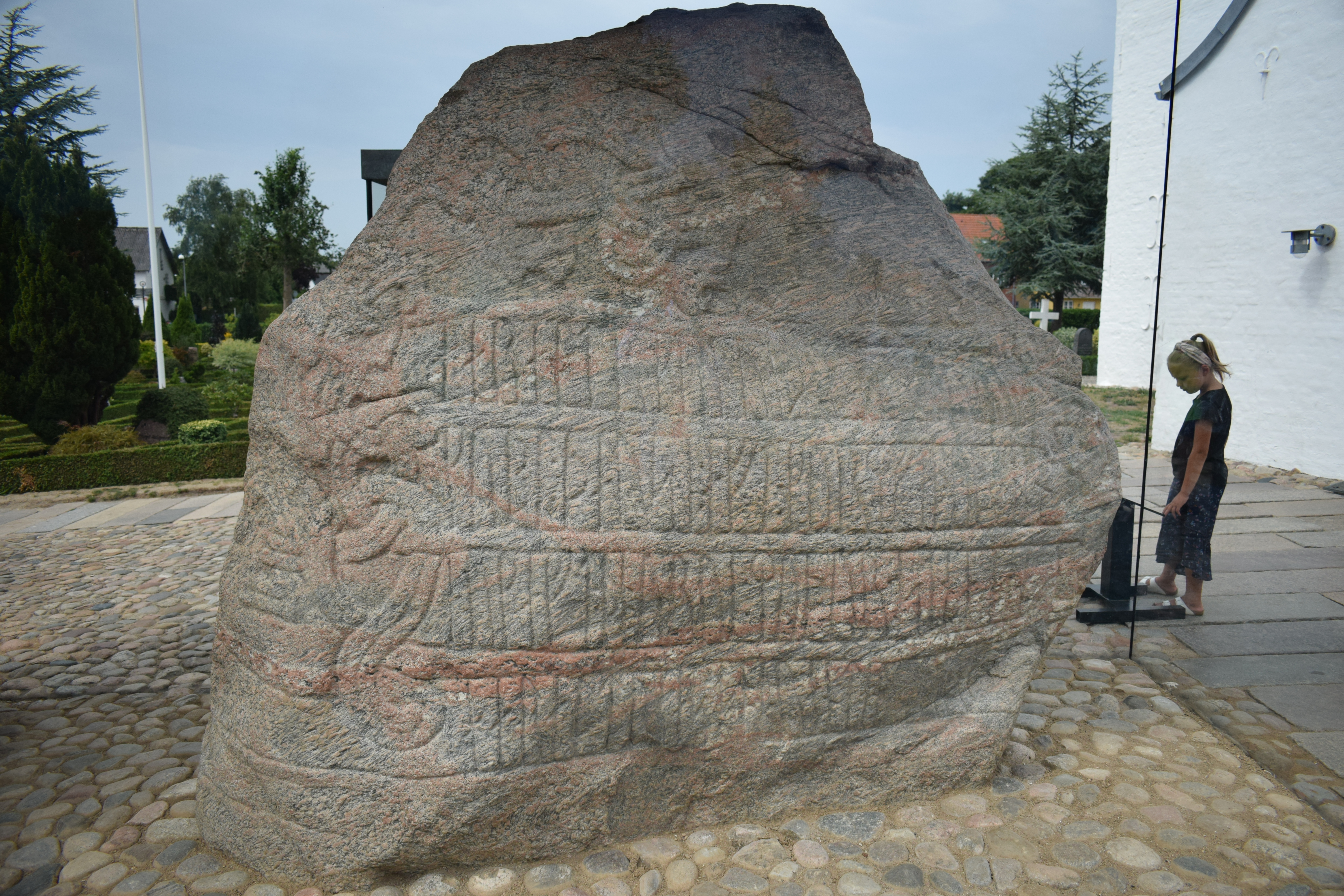
| Location | Jelling, Denmark (in front of Jelling Church, its original site) |
|---|---|
| Date | 10th century, c. 965 AD |
| Commissioned by | King Harald Bluetooth (Haraldr Gormsson) |
| Script | Younger Futhark |
Harald Bluetooth raised this stone in memory of his parents, Gorm and Thyra, but its real significance is political and religious: it records Harald’s claim to have won all of Denmark and Norway, and to have made the Danes Christian. One face carries the oldest known Scandinavian depiction of Christ. Because of that claim, the stone is sometimes nicknamed “Denmark’s baptismal certificate” — it’s one of the earliest surviving documents of the country’s own name and Christian conversion, in its own words.
Why it matters here: Jelling shows runes used for state propaganda, not just personal memorial — a genre this site’s other pages (Names, Phrases) don’t usually cover. It’s also a good example of how a “translation” of a runic inscription is really a translation of Old Norse grammar and vocabulary carved in runes, not a different language from the Old Norse this site’s translator works with.
The Ramsund Carving (Sö 101)
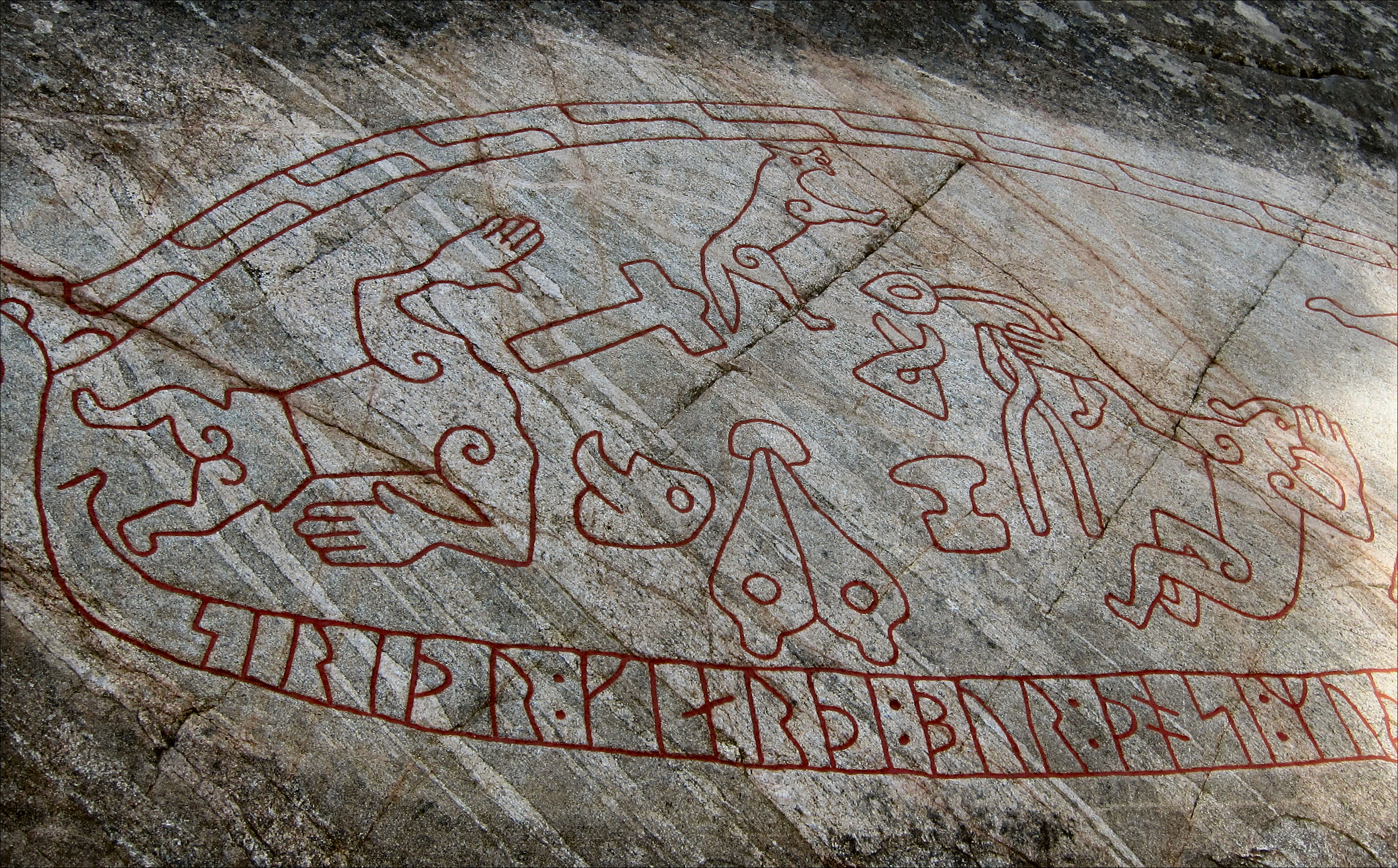
| Location | Near Ramsund, Eskilstuna Municipality, Södermanland, Sweden |
|---|---|
| Date | c. 1030 AD |
| Surface | A natural bedrock outcrop, not a carved standing stone |
| Script | Younger Futhark |
Ramsund isn’t a memorial inscription in the usual sense — it’s a picture carving, using the outline of the runic serpent itself as the border of a comic-strip-like narrative. It illustrates the legend of Sigurd the dragon-slayer: Sigurd tasting the dragon Fáfnir’s blood while roasting its heart for his foster-father Regin, the birds who warn him that Regin means to betray him, Regin’s death with his own smithing tools scattered around him, and Sigurd’s horse Grani carrying off the dragon’s treasure. It’s the same Sigurd legend later written down in the Old Norse Völsunga saga and the Poetic Edda.
Why it matters here: the runic text on the border is genuinely hard to interpret and doesn’t clearly name the carving’s sponsor — a good, honest example that not every runic inscription has a fully solved reading, even famous ones. It also shows runes used to caption a mythological scene rather than to state a memorial formula, which is a different job than what most surviving runestones do.
The Karlevi Stone (Öl 1)

| Location | Karlevi, island of Öland, Sweden |
|---|---|
| Date | Late 10th century |
| Height | Approximately 1.4 m |
| Script | Younger Futhark |
Karlevi is set apart from every other runestone in this gallery — and almost every runestone anywhere — because its inscription is a complete stanza of skaldic poetry in dróttkvætt (“lordly meter”), the same tightly patterned verse form used in court poetry for kings. Most runestones use a short, formulaic memorial sentence; Karlevi uses kennings (indirect poetic name-substitutions, like calling a ship “the sea’s horse”) referencing the god Odin and Thor’s daughter Þrúðr to praise a fallen chieftain, likely connected to the Battle of Fýrisvellir. It’s widely cited as the oldest surviving record of a complete dróttkvætt stanza in any medium.
Why it matters here: if you’ve used this site’s Medieval or Old Norse tools and wondered what real “high style” Old Norse poetry looked like rather than everyday memorial prose, Karlevi is the clearest surviving runic example — proof that runes could carry genuine literary art, not just names and dates.
The Dynna Stone (N 68)

| Location | Museum of Cultural History, Oslo, Norway (found in Dynna, Gran, Oppland) |
|---|---|
| Date | c. 1040–1050 AD |
| Script | Younger Futhark |
Transliteration: Gunnvǫr gerði brú, Þrýðríks dóttir, eptir Ástríði, dóttur sína.
Translation: “Gunnvǫr made the bridge, Þryðríkr’s daughter, in memory of Ástríðr, her daughter. She was the handiest maiden in Haðaland.”
Dynna is a memorial raised by a mother, Gunnvǫr, for her daughter Ástríðr — one of the relatively rare runestones sponsored by a woman for another woman. The carving above the text shows a nativity scene: the infant Jesus, the star of Bethlehem, and the three wise men on horseback, making it one of the earliest surviving pieces of Christian pictorial art from Norway. Building a “bridge” was a common act of Christian piety recorded on runestones of this period, often referring to a causeway or raised road rather than a literal bridge.
Why it matters here: Dynna is a useful counter-example to the idea that runestones are always about warriors and kings — this one is a personal, domestic memorial between two women, carved with imported Christian iconography rather than Norse mythology, at a moment when the two belief systems overlapped in daily life.
How to read a real inscription yourself
The stones above are transliterated from runes into Latin letters, then translated into modern English — two separate steps, each with its own uncertainty. If you want to understand that process in more depth, see the Rune Transliteration Guide for how runologists handle word dividers, damaged sections, and spelling conventions, and Elder vs Younger Futhark for why the same sound can be written with different runes depending on the period and system. This site’s own Rune Translator and Younger Futhark Translator do the reverse job — converting modern text into runes for names, tattoos, or study — and are not a substitute for the scholarly readings shown on this page.
Frequently asked questions
Are these the “best” or most famous runestones in the world?
They’re a representative sample chosen to show different jobs runes actually did — a riddle-memorial (Rök), political propaganda (Jelling), a mythological picture caption (Ramsund), a poem (Karlevi), and a personal Christian memorial (Dynna) — not a ranked top-five list. There are thousands of surviving runestones; this gallery will grow over time.
Can I trust the translations shown here?
They reflect the standard scholarly readings recorded in Rundata and cross-referenced against published research, not this site’s own translation tool. Where a reading is genuinely disputed (as with parts of the Ramsund inscription), that’s stated rather than smoothed over.
Why do some words have symbols like ǫ, þ, or ʀ?
These represent real Old Norse sounds that don’t exist in modern English: þ (“thorn”) is like the “th” in “thin,” ǫ is a rounded back vowel, and ʀ represents a distinct r-sound that later merged with regular r in most dialects. They’re kept in scholarly transliterations rather than simplified away.
Can I use these photos myself?
The photos are hosted on Wikimedia Commons under Creative Commons licenses, and each caption above credits the photographer and links to the specific license terms and the original file page — check those terms directly before reusing an image elsewhere.
Did you visit these stones in person?
No — the photographs are credited to their original Wikimedia Commons contributors, and the readings are drawn from published runological sources rather than firsthand fieldwork. That’s stated plainly here rather than implied otherwise.
Spotted an error in a reading, date, or attribution above? Please use the Corrections Policy page to report it.